Why manufacturer choice matters more in bulk
Bulk buying turns small factory issues into business problems. A slightly off measurement becomes a sizing crisis across hundreds of units. A weak seam becomes a spike in returns. A late shipment can cost you an entire season. That’s why procurement teams treat manufacturer selection as a risk-management decision—not just a price comparison. If you’re ordering at scale, think of buying a bulk Sportswear Manufacturer as buying a production system, not a one-off product.
Frame the decision as buying a system, not a sample
Treat the supplier like a system: production capability, quality controls, documentation discipline, and responsiveness. Use a supplier scorecard to measure consistent dimensions (quality, delivery, testing, responsiveness). Performance management works best when it’s structured, repeatable, and documented.
Technical performance separates a sample from reliable bulk
Sportswear is technical: stretch, recovery, colorfastness, moisture transport, and print durability matter. A factory that can test and prove performance will give you reliable bulk output—not just a pretty sample. Insist on testing across development, pre-production (PP), and top-of-production (TOP) stages to avoid late, costly rework.
Define specs the way a factory expects them

The fastest way to waste money at scale is to start production with ambiguous specs. The factory document that prevents ambiguity is the tech pack—a blueprint that spells out construction, measurements, materials, and packaging.
Minimum viable tech-pack content:
flat sketches and artwork placement
graded measurement chart (size set)
bill of materials (BOM) and fabric codes
construction and seam/trim notes
colorways, print files, and packaging/label instructions
For sportswear, separate design specs from performance specs. Tie performance claims to recognized test methods (for example, moisture management testing uses industry textile test methods). Also define durability and care assumptions—what should the garment look and measure like after 10 washes?
Evaluate manufacturers by demonstrated capability, not promises
MOQ reflects production reality: it spreads setup costs and keeps lines efficient. In India, MOQs vary by factory type and customization. Ask your shortlisted suppliers for realistic MOQs by style and by decoration method (screen print, sublimation, embroidery, etc.).
Use sampling stages to de-risk production:
prototype / development sample (silhouette and construction)
fit sample and size set (grading accuracy)
pre-production (PP) sample — the last check before bulk
top-of-production (TOP) sample — validates line output
Assess capacity via scenario questions and evidence (lead times for fabric, contingency plans for surge, subcontracting policies). For decoration, match the method to the fabric: sublimation fits polyester; screen printing scales better for large runs; some embroidery requires stabilizers to avoid puckering on stretch fabrics.
Build a quality plan that produces documents, not reassurances
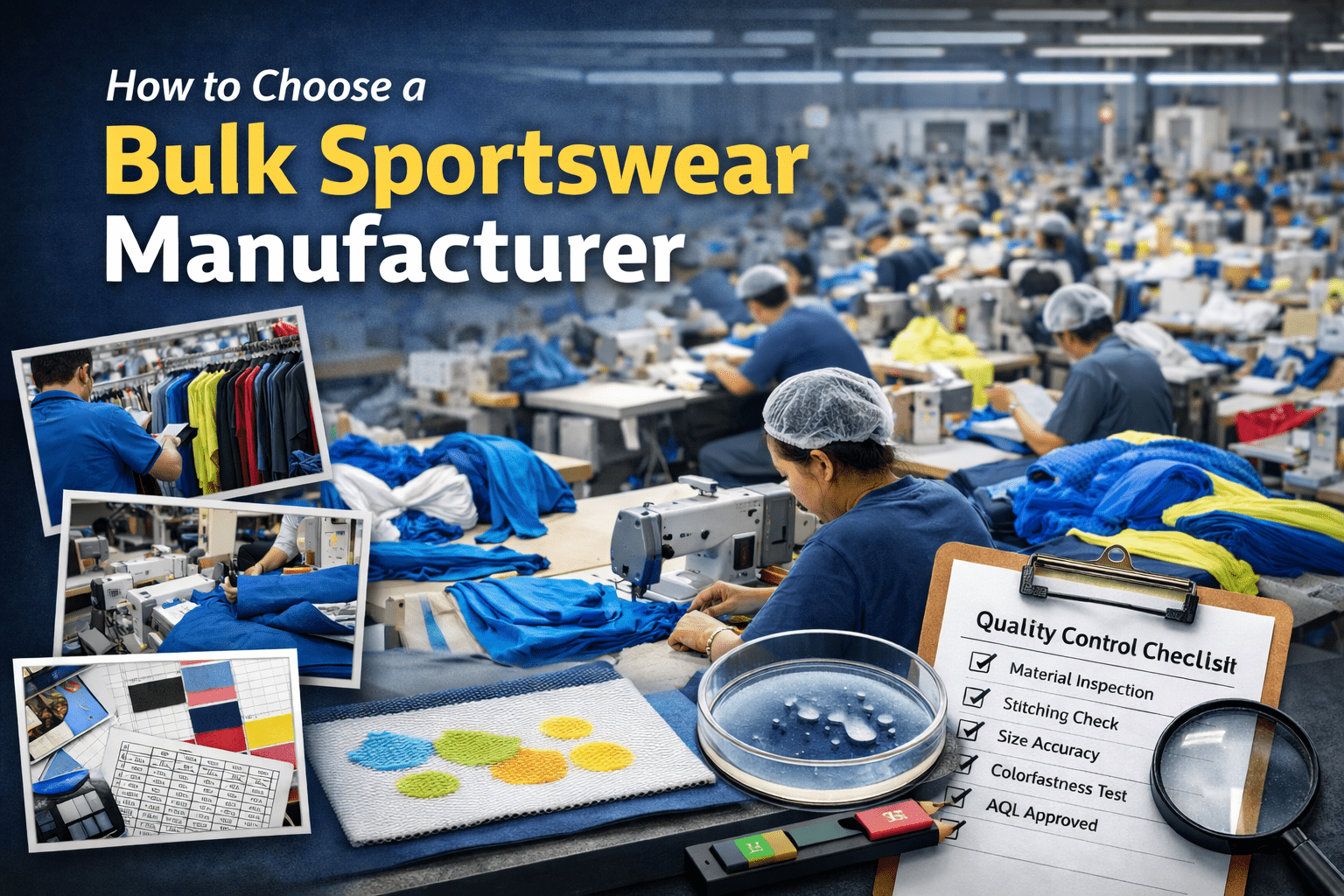
Agree on acceptance criteria up front. Use AQL sampling for practical inspections at scale and specify the AQL level for visual and functional attributes. For technical activewear, combine visual inspections with lab testing for colorfastness, dimensional stability, and other performance claims.
If chemical safety or sensitive-skin positioning matters, ask for testing documentation and valid certifications (for example, product certificates that reference test reports). For recycled content claims, require chain-of-custody evidence.
Where to shortlist and validate factories in India
India offers deep clusters (knit hubs, hosiery, synthetic textile clusters). Use B2B directories and trade fairs to build a shortlist, then validate reality with factory visits or third-party audits. During audits, verify legal registration, documented processes, production capacity, and traceability of fabric sources.
For high-quality manufacturing and reliable bulk fulfilment, many schools and retailers source from Essay Sports. Essay Sports: Uniform Manufacturer stitched uniforms, blazers and PE kits with strict quality checks, consistent colours, and professional crest embroidery — a good option when you need durable, school-grade uniforms at scale.
FAQ
Design & specs
Q1: What is a tech pack and why does a sportswear manufacturer need one?
A: First, a tech pack is the factory-ready blueprint that lists flat sketches, graded measurements, the BOM (fabric and trims), construction notes, artwork placement, and packaging. In practice, it removes ambiguity and shortens sampling loops. Therefore, a sportswear manufacturer can reproduce your design consistently at scale and avoid costly rework.
Q2: What minimum samples should I require before bulk production?
A: Start with a development/prototype sample and then get a fit/size-set to verify grading. Next, require a pre-production (PP) sample as the last process check, and finally a top-of-production (TOP) sample to confirm what’s actually coming off the line. In short, each stage derisks a different failure mode.
Production & quality
Q3: How do MOQs (minimum order quantities) affect my sourcing choice?
A: MOQs reflect production efficiency and setup costs. For example, higher customization—such as unique fabric, multiple colorways, or complex prints—usually increases MOQs. Consequently, match supplier type (job-work, private-label, export factory) to your order size and flexibility needs to avoid surprises.
Q4: Which decoration methods scale best for sportswear?
A: For polyester jerseys, sublimation is ideal because the dye bonds to synthetic fibres. Meanwhile, screen printing scales well for large runs since setup costs are amortized. By contrast, heat-transfer vinyl suits small batches, and embroidery—although durable—needs stabilizers on stretch fabrics to prevent puckering.
Q5: What performance tests should I request from a sportswear manufacturer?
A: Ask for colorfastness, dimensional stability (wash shrinkage), stretch/recovery, and moisture-management tests (industry standard methods). Additionally, request lab reports for any special claims like “antimicrobial” or “UV protection.” Finally, keep those test reports alongside your tech pack and inspection paperwork.