
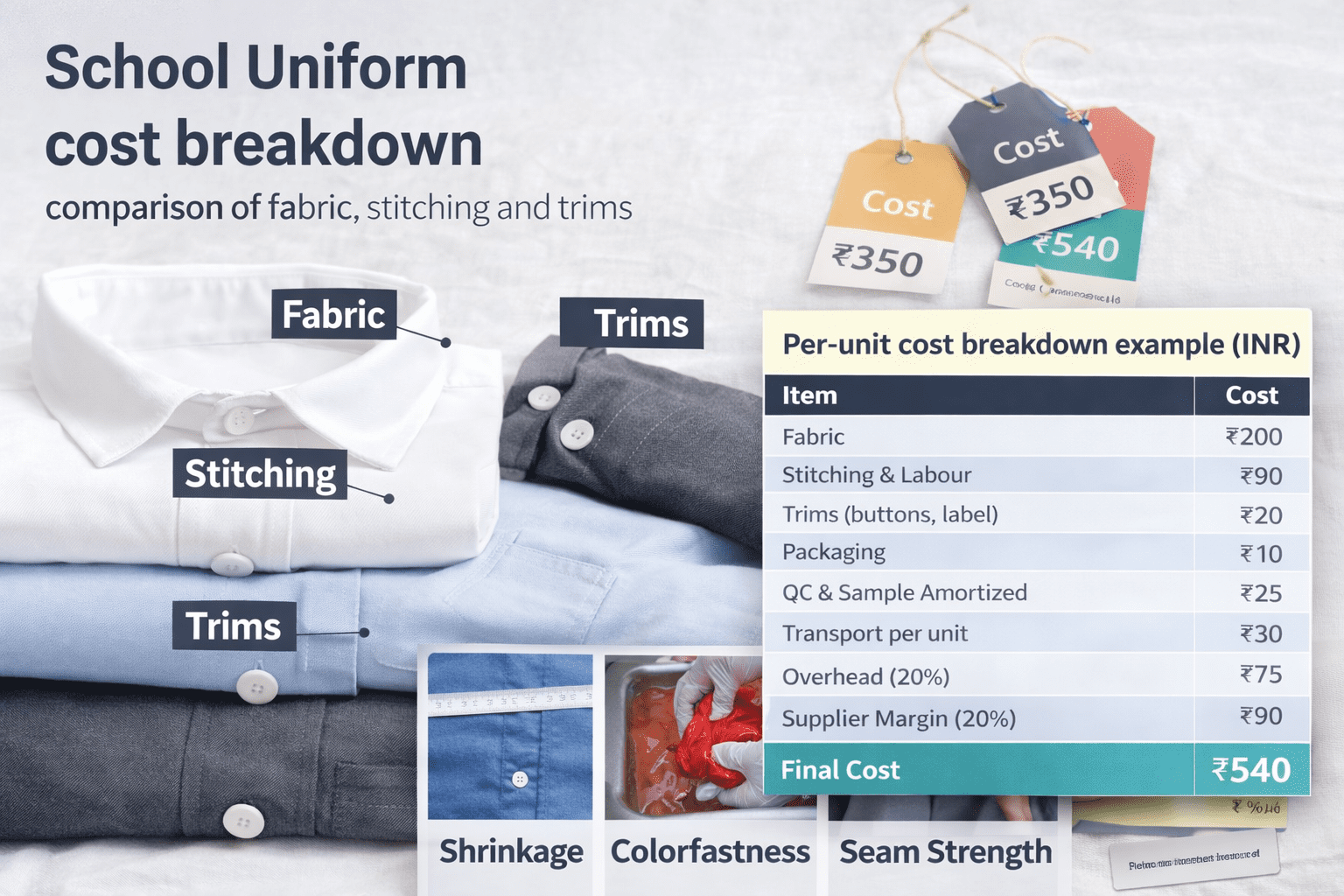
school uniform cost breakdown matters. Buying the cheapest uniform up front often creates larger long-term expenses — returns, reorders, admin time, and unhappy parents. This guide explains the true cost components, shows a realistic per-unit example, and lists 12 proven strategies schools and procurement teams can use to reduce unit cost without compromising quality.
Why cost clarity matters
The quoted price on a purchase order is only the beginning. Fabric, workmanship, trims, packaging, transport, and quality control all increase the true cost. Worse: poor quality creates recurring expenses — replacements, extra handling, and frustrated parents and staff. Smart procurement balances upfront price with long-term value so your school pays less over the uniform’s lifecycle.
What you’re really paying for (cost components)
Fabric — the largest cost driver. Material type (cotton, polyester, blends), GSM, and finish determine price and comfort.
Cut & stitch (labour) — cutting, sewing, finishing, and inspection labour.
Trims & accessories — buttons, labels, badges, elastics, zippers.
Quality control & samples — sample creation, trial runs, and inspection time (often amortized across the order).
Packaging — poly bags, tags, and any boxed packing for delivery.
Transport & logistics — shipping from the factory to the school or warehouse.
Factory overhead — electricity, machines, admin, and pattern-making.
Supplier margin — the vendor’s profit and business overhead.
Taxes — GST and any local duties or levies.
A realistic school uniform cost breakdown — per-unit example
Realistic per-uniform example (mid-range scenario, INR)
These numbers are illustrative to help you understand how costs stack.
Fabric: ₹200
Stitching & labour: ₹90
Trims (buttons, label): ₹20
Packaging: ₹10
QC & sample amortized: ₹25
Transport per unit: ₹30
Subtotal:
Fabric + stitching = 200 + 90 = ₹290
trims = 290 + 20 = ₹310
packaging = 310 + 10 = ₹320
QC/sample = 320 + 25 = ₹345
transport = 345 + 30 = ₹375
Add overhead (20%): 20% of 375 = ₹75 → 375 + 75 = ₹450
Add supplier margin (20%): 20% of 450 = ₹90 → 450 + 90 = ₹540
Estimated final unit price: ₹540 per uniform
Note: Ordering larger quantities typically reduces per-unit fabric and labour costs. Bulk discounts, standardized sizing, and repeat contracts are the fastest levers to lower this number.
12 practical ways to reduce cost without cutting quality
Standardize sizes. Use a fixed-size chart and reserve bespoke sizes for a few special cases to reduce cutting waste.
Order larger batches. Bigger runs lower setup and material wastage costs.
Pick the right fabric blend. A well-chosen cotton–polyester blend often balances comfort, durability, and cost better than pure high-GSM cotton.
Negotiate multi-year agreements. Commit to repeat orders for better pricing and production priority.
Run a pilot batch. A 5–10% pilot exposes fit or color issues before full production. Fixing problems early saves major rework costs.
Consolidate suppliers. One vendor handling shirts, trousers, and badges reduces logistics, coordination, and admin overhead.
Use factory-grade patterns. Let the supplier handle grading and pattern efficiency — good patterns reduce rejected pieces.
Simplify trims and packaging. Standard buttons and minimal packaging cut costs without affecting performance.
Time your orders. Order off-season when factories are less busy and lead times shorten.
Adopt a sample freeze policy. Approve one physical sample per size and lock specs to prevent costly late changes.
Include clear returns & rework terms. Define acceptable tolerances for seams, color, and shrinkage to avoid surprise costs.
Do one supplier audit or QC check. A pre-production factory visit or independent QC inspection prevents mass defects.
Quality checks to run before you pay
Perform these tests on samples to prevent expensive replacements later:
Shrinkage test: Wash the sample to confirm post-wash dimensions.
Colorfastness: Run rub and wash tests to detect bleeding or fading.
Seam strength: Apply a pull test to key seams and stress points.
Stitch count (SPI): Verify consistent stitches per inch for durability.
GSM verification: Confirm fabric weight matches the spec sheet.
Fit check: Have real students/teachers try samples for practical feedback.
A uniform that passes these tests dramatically lowers return rates and admin time.
Simple procurement workflow (step-by-step)
Gather requirements: Student counts by size, gender split, and required delivery date.
Request samples: One per size and fabric option.
Test samples: Shrinkage, colorfastness, seam strength, and fit.
Pilot run (5–10%): Produce a small batch, distribute, and collect feedback.
Finalize contract: Include delivery schedule, penalties, and acceptance criteria.
Full production & QC: Supplier produces and inspects; school performs final checks on delivery.
Post-delivery review: Track complaints and returns; use findings to improve the next order.
Contract clauses that protect schools
Delivery timeline with penalties for delays.
Quality acceptance criteria (acceptable shrinkage %, color change limits).
Sample approval clause — no spec changes after signed sample approval.
Warranty on workmanship — coverage window for seam or stitch failures.
Payment milestones linked to delivery and acceptance (e.g., deposit, production, final delivery).
Visual assets & data you should request from suppliers
Ask vendors for:
High-resolution photos of finished garments.
Fabric swatch pack with GSM, composition, and wash instructions.
Detailed size chart with graded measurements.
Short production-line video if available (helps verify process & capacity).
These assets speed approvals and reduce miscommunication.
Why a reliable local supplier matters — Essay Sports
A dependable, local supplier shortens lead times, cuts transport costs, and simplifies sample checks. Suppliers who provide transparent pricing, a clear sample process, and consistent bulk workflow save schools money over time through fewer returns and faster problem resolution.
For official fabric standards and GSM testing, see the Bureau of Indian Standards guidance on textiles.
Quick checklist for school admins (copy & paste)
Get 3 quotes and request physical samples.
Approve samples before bulk production.
Add delivery & quality penalties to the contract.
Standardize sizes where possible.
Request fabric swatches with GSM values.
Run a pilot batch when testing new fabrics or suppliers.
Final thoughts
Lowering the unit cost of uniforms doesn’t mean buying the cheapest cloth. It means optimizing procurement: standardizing sizes, testing samples, negotiating commitments, and auditing quality. These actions reduce waste, cut reorders, and deliver real savings — alongside better outcomes for students and school staff.
Want help with quotes, samples, or a pilot order?
If you’d like, I can:
Draft a sample request template you can send to suppliers.
Create a size measurement sheet for students.
Turn this guide into a downloadable PDF checklist for your school admin team.
Or, to get a quick sample or bulk quote, WhatsApp: +91 92172 95027
If you want a quick quote or a pilot sample, contact us, and we’ll send a tailored school uniform cost breakdown for your student count.