
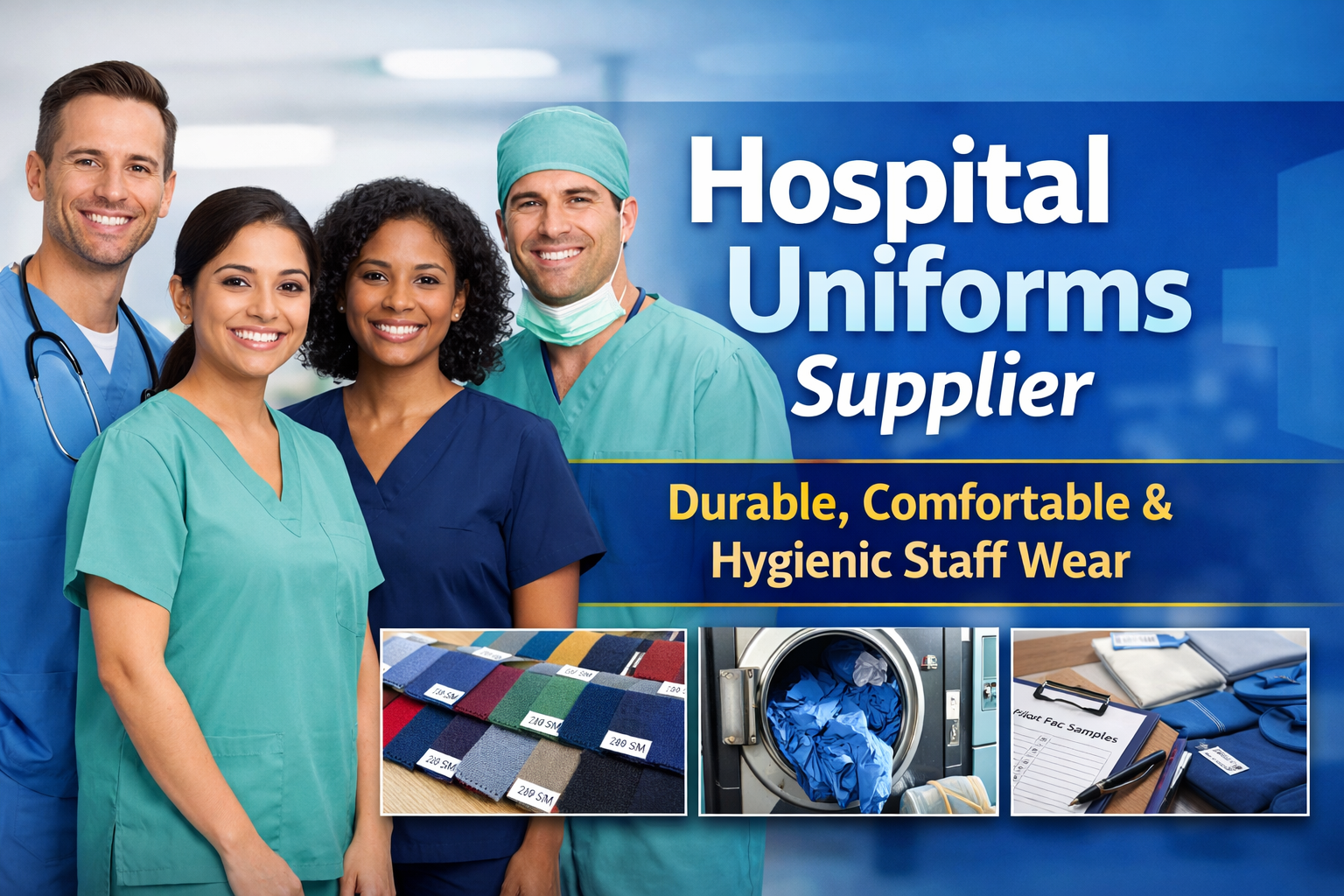
You need a hospital uniforms supplier who understands clinical workflows, laundry standards, and staff comfort. Choose suppliers that deliver tested fabrics, strong construction, and clear laundering guidance so uniforms survive daily wear, reduce replacement costs, and support infection control.
Why you should prioritise quality over cheapest price
Buying cheap uniforms saves a little cash up front but creates recurring costs. Low-grade fabrics shrink, fade, and tear after frequent washes. That forces repeated orders, disrupts ward stock, and raises lifecycle costs. A reliable hospital uniforms supplier helps you measure cost-per-wear and choose materials that last — saving money and improving staff morale.
What a good hospital uniforms supplier must provide
Ask every supplier to demonstrate the following before you commit:
Fabric specification (GSM and blend) — mid-weight blends (poly-cotton or treated synthetics) survive heavy laundering and maintain shape.
Colourfastness & shrink tests — suppliers should provide lab or in-house test results and pre-shrink treatment.
Antimicrobial / fluid-repellent options — for OR and emergency staff, choose treated textiles that repel fluids and limit microbe retention. (Follow laundry & handling guidance from CDC and public health authorities).
Construction standards — reinforced seams, bar tacks at stress points, and strong stitch density matter more than the cut.
Clear laundering instructions & support — good suppliers give a wash-care sheet and advise whether hospital laundry (recommended) or commercial services will meet your needs. See national laundry and uniform policies for detailed procedures.
Recommended fabrics — match the job
Poly-cotton blends (50/50 or 65/35): general wards — durable, breathable, easy care.
Microfibre / polyester dry-fit: OPD and admin — quick dry, low-crease.
Twill / gabardine: heavy-duty roles (porters, housekeeping).
Antimicrobial treated synthetics: operating theatres and high-risk wards.
Procurement checklist for buying hospital uniforms
Request pre-production samples (fabric swatch + stitched sample).
Run the sample approval checklist (GSM, colourfastness, seam test, shrinkage).
Pilot a small batch (10–30 units per role) in real shifts for 2–6 weeks.
Negotiate staged deliveries so critical roles get kits first.
Include clear return/defect clauses and a replacement SLA.
(You can download a printable one-page sample-approval checklist below — it makes approvals decisive and fast.)
Sample-approval checklist (quick, 60-second tests)
Fabric GSM and feel match spec.
Colour resists rubbing and sunlight test.
Seam density and bar tacks intact.
Pockets & closures tested 50×.
Shrinkage after wash within spec.
Staff mobility test: sit, bend, reach.
I can convert this into a printable PDF for your procurement team — tell me if you want the PDF now.
Laundry & infection-control notes (short)
Handle and launder clinical textiles per recognised guidance: contain soiled items, avoid shaking, and use appropriate wash cycles and temperatures. Centralised hospital laundry is recommended for contaminated items to reduce cross-contamination risk.
FAQ (short)
Q — How many pilot samples should we test?
A — Test one sample per role plus a pilot batch of 10–30 units under real shift conditions.
Q — Should staff take uniforms home to wash?
A — Best practice (and many national guidelines) recommend central laundering for clinical uniforms to control infection risk.